Design end-to-end — whiteboard sketch to live pilot. 4 agents shipped, 1 held back as the Guardian decision.
— Worked with
2 PMs + full dev + QA team. 12 studios across US, Japan, and Korea in active pilot — paying users, not engagement clicks.
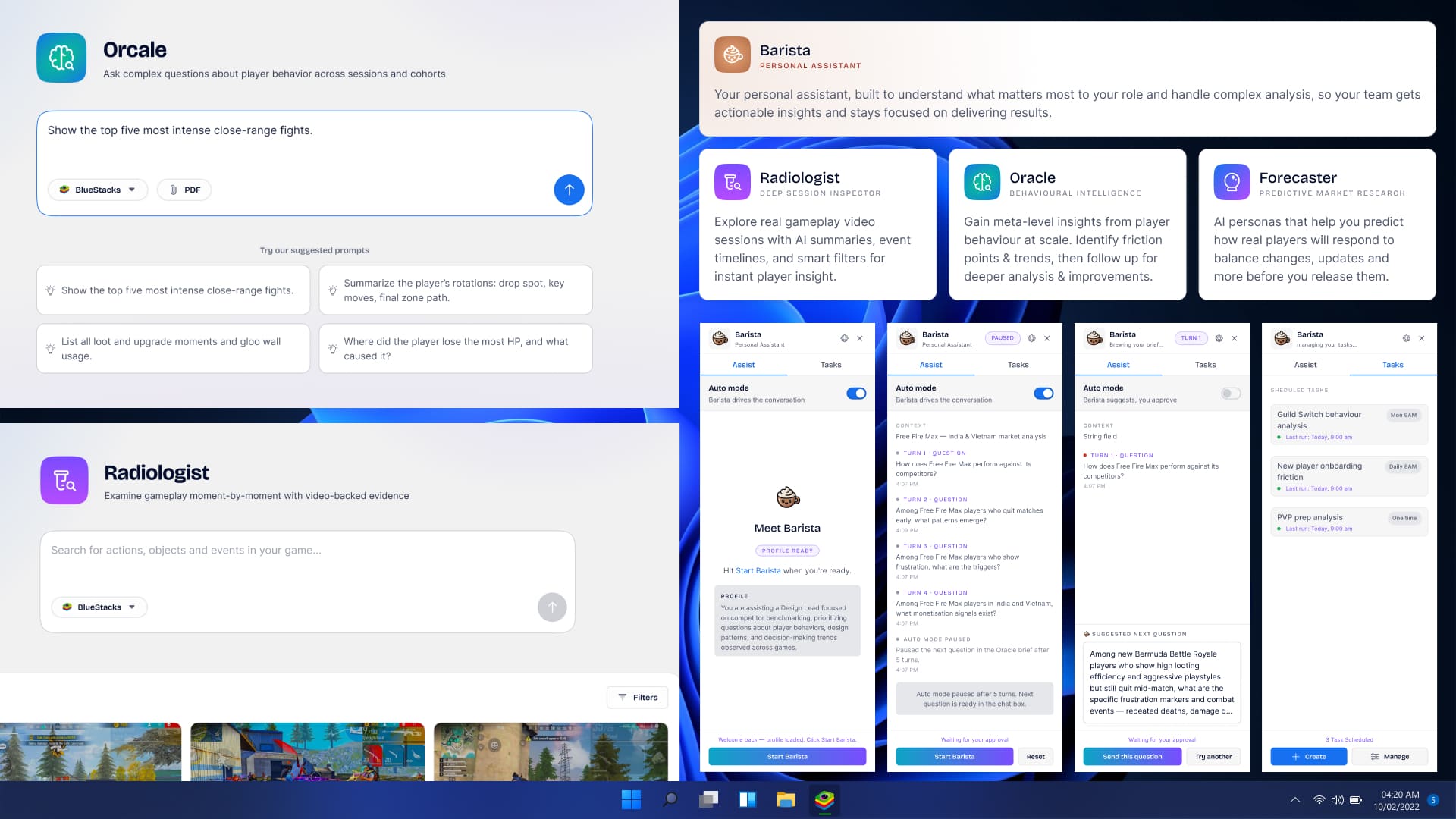
Four agents, one surface
FIG. 01 / OVERVIEW
6labs.ai · ai platform · b2b
2025 — NOW
● PILOT · 12 STUDIOS
6labs.ai
The short version.
Full story · ~9 min read below
Problem
Game studios paid twice to understand players: once to run playtests, again to have people watch the recordings. BlueStacks had millions of hours of real gameplay video nobody was mining.
My role & team
Sole designer, from whiteboard sketch to live pilot, with 2 PMs and a full dev + QA team.
What shipped
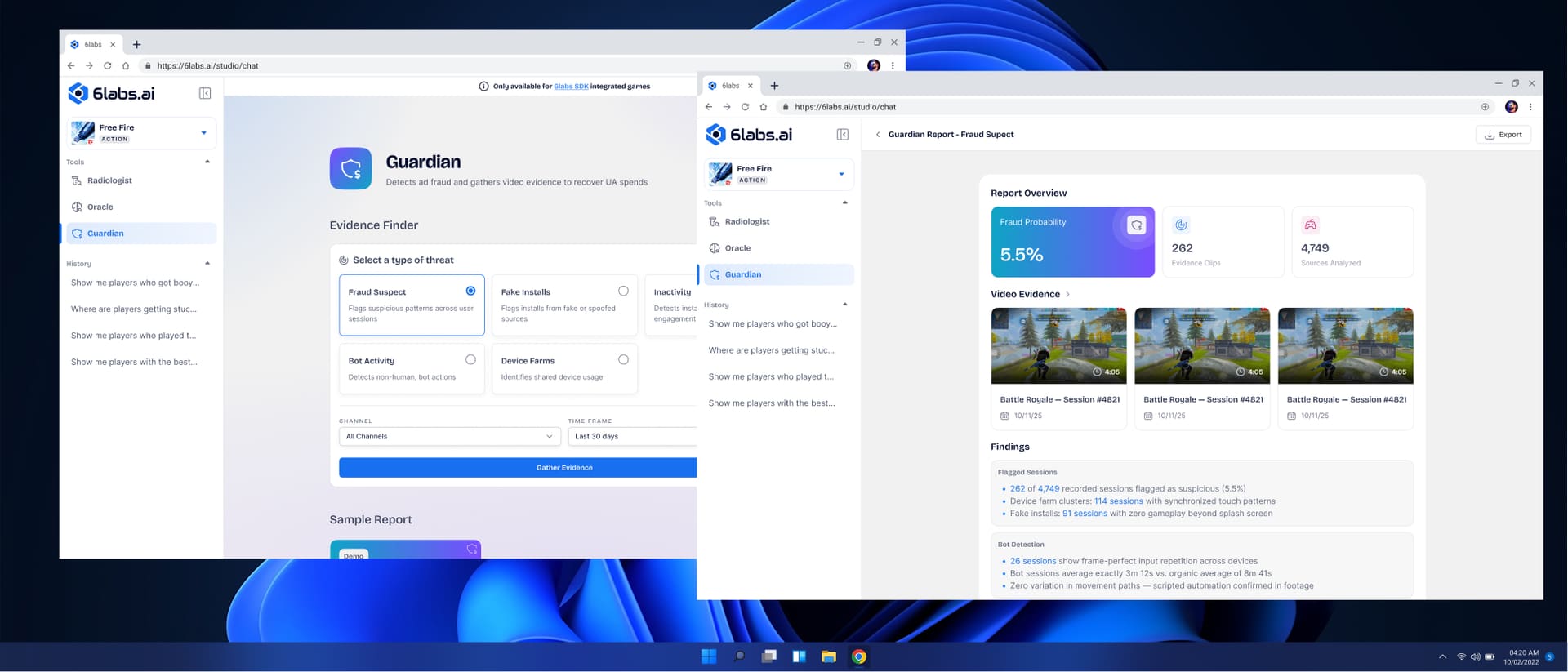
A 4-agent product (Oracle, Radiologist, Barista, Forecaster) that answers “where are players getting stuck” in seconds, with video as proof. One agent, Guardian, held back on purpose.
Outcome
12 studios in active pilot across the US, Japan and Korea. Paying users, including a Free Fire–class title.
§00Where it stands, today.pilot · 2026 Q2
12 studios in paid pilot across the US, Japan and Korea; four agents live, Guardian held back on purpose.
12
Game studios signed in 30 days
Commercial conviction, not engagement — devs paying to use the product, not just clicking around. More joining each cohort.
4
Agents shipped, one held back
Barista, Radiologist, Oracle, Forecaster live. Guardian (ad-fraud detection) held back — sensitive territory dealing with real money, needs more accuracy testing first.
3
Iterations of the product I led
Filtered video POC → natural-language + 2 agents → Barista as the orchestrator. Each move driven by what we learned from the previous one.
§01The goldmine sitting in plain sight.setup
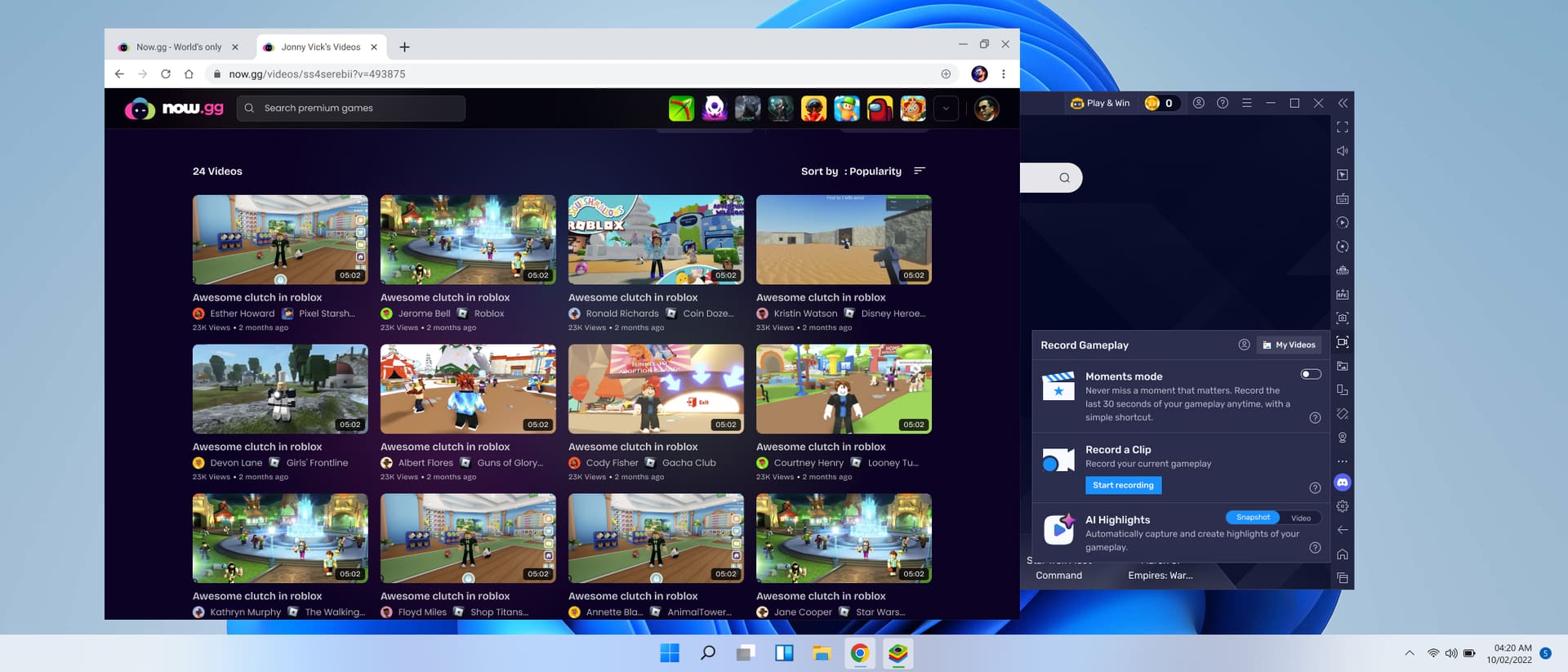
BlueStacks' AI Highlights had captured millions of hours of real player sessions while studios still paid people to watch playtest recordings.
BlueStacks had been capturing real gameplay video at scale through AI Highlights inside the App Player. A constantly growing corpus of unprompted, real-player sessions across hundreds of titles.
Game devs' status quo for understanding their own players had not changed: schedule playtests, watch hours of recordings, write notes. Slow. Biased. Small-N.
Mid-2024 onwards, AI productivity tools were reshaping every adjacent industry. Every dev tooling roadmap had an AI line item.
Internal read at BlueStacks: we're sitting on a goldmine devs would pay for. Leadership assigned the work. I was the sole designer.
§02Making the bet a real product.framing
Leadership's bet became a product through three questions and two constraints: every insight traceable to real video, usable on day one.
Leadership had the idea: an AI platform trained on our gameplay corpus, giving devs superpowers in player understanding. My job was to translate that into a product. Three sub-questions had to be answered before any UI got drawn.
Q1 · CAPABILITY CEILING
What insights can this data actually surface?
What can the model reliably extract from raw gameplay video — and what's a stretch?
Q2 · VALUE FLOOR
Which of those would change a dev's work?
An impressive insight that doesn't change a roadmap is just a parlor trick.
Q3 · ACCESS
How does a dev reach those insights?
Without being a data scientist. Without writing SQL. Without learning a new craft.
Two constraints I set early to keep the work meaningful, not just impressive:
Every insight must be traceable back to real video. Devs trust their eyes, not stats. Ungrounded AI summaries get ignored.
Devs should be able to use it day one — no training, no new craft to learn. AI's job here is to remove the data-science barrier, not introduce a new one. If a dev has to study the product before it pays off, the bet has already failed.
These two constraints ended up shaping every iteration that followed.
§03Three iterations, one held back.the design moves
Three iterations: filtered video, then two agents behind a plain-language box, then Barista to propose the question devs didn't know to ask.
The product evolved across three iterations, each driven by what we learned from the previous one. A fifth agent exists but didn't ship — and that decision matters as much as the ones that did.
Three iterations, one frame
01 / 03
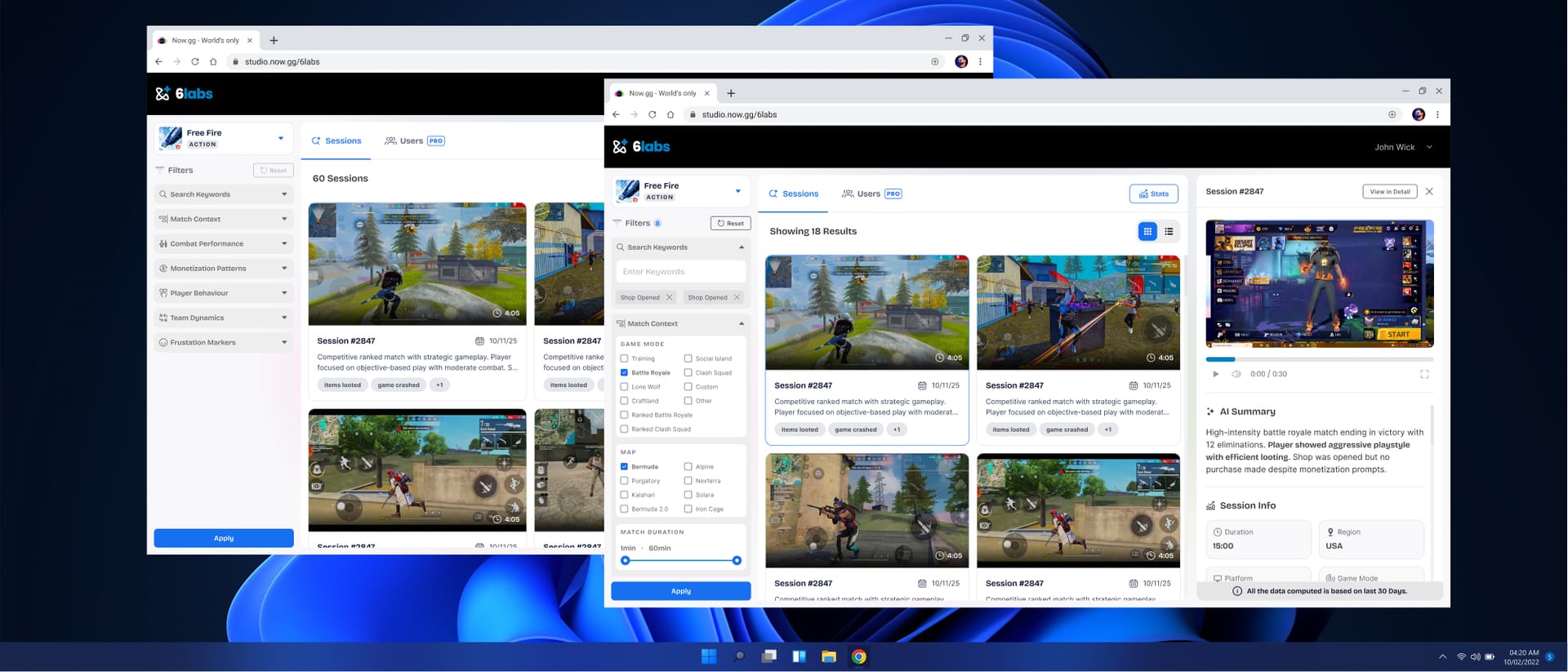
Iteration 01 — Cut the watching, not the proof.
Expand scope. Move from filtered playback to generated insights, with video as evidence underneath.
ITERATION 01POC · FILTERED VIDEO
Cut the watching, not the proof.
The dev problem
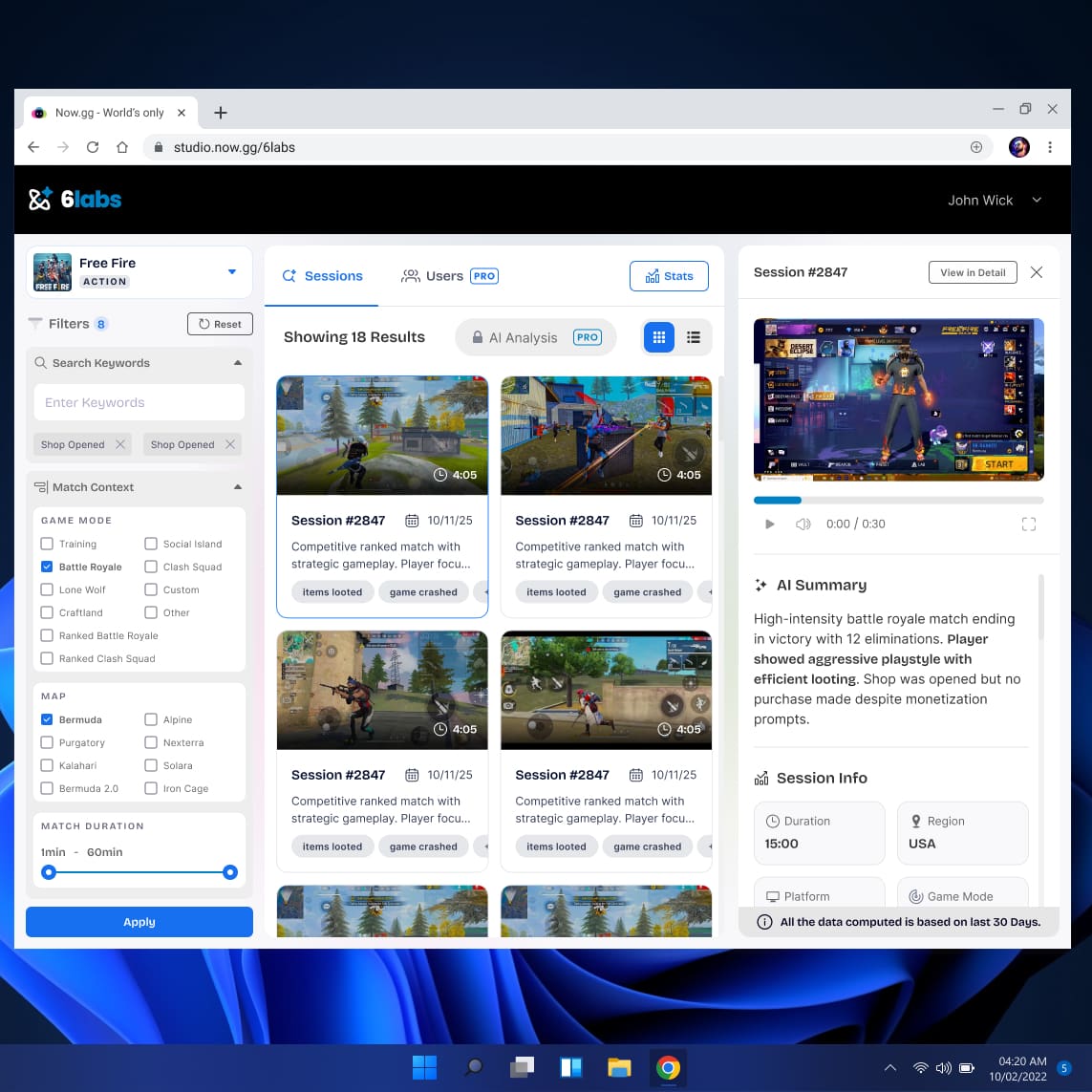
Studios were burning real money to understand their own players. They'd commission playtests, then assign people to watch the recordings to find the moments that mattered. The cost was paid twice — once to run the playtest, again to extract value from it manually.
What we built
An AI auto-tagged every video in our corpus across player-behaviour signatures. Devs filtered by those tags to surface the exact sessions they wanted, instead of trawling through every session. Limited dev resources, narrow scope.
What we learned
Devs liked it — already faster than the playtest-then-watch loop. Feedback was consistent: “go further. We don’t want to watch better videos. We want the answer, with the videos as proof.”
Decision
Expand scope. Move from filtered playback to generated insights, with video as evidence underneath.
ITERATION 02AI-NATIVE · TWO AGENTS
Ask in plain language, get the answer back.
The dev problem
Filters surfaced sessions; they didn’t answer questions. Devs across roles asked very different things, and a static filter UI couldn’t cover that surface area.
What we built
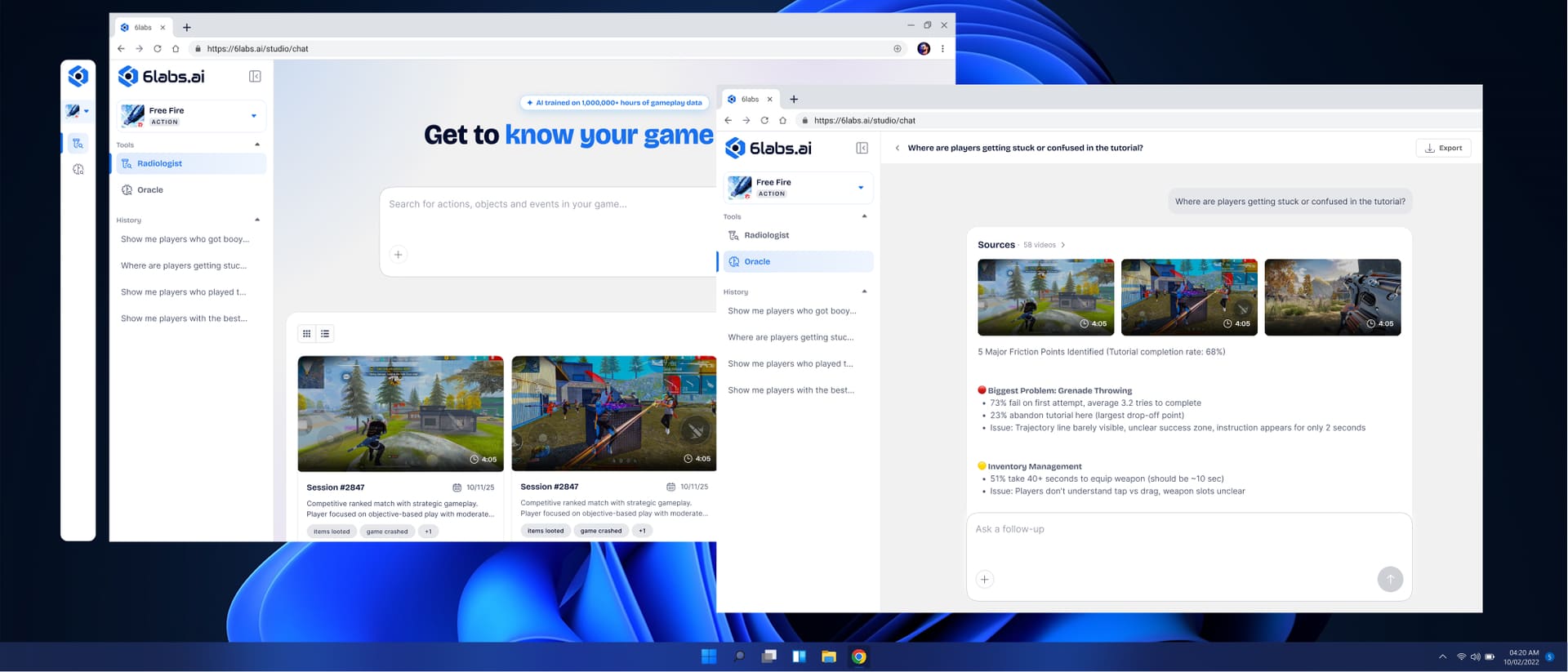
A natural-language input field, two agents behind it. Radiologist built on top of the filter piece — adds AI session summaries, a timeline of key events, and session metadata (region, platform, device, length). Oracle, experimental — answers focused dev queries across many sessions: “where did players lose the most HP and what caused it?”, “summarise rotation, drop spot, key moves, final-zone path.”
What we learned
Both agents worked technically. But devs hit a learning curve we hadn’t fully predicted — even with suggested queries and hints, devs didn’t know what to ask a system this powerful. The capability was there; the access wasn’t.
Decision
The next move had to solve query authoring, not agent quality.
ITERATION 03ON-RAMP · ORCHESTRATOR
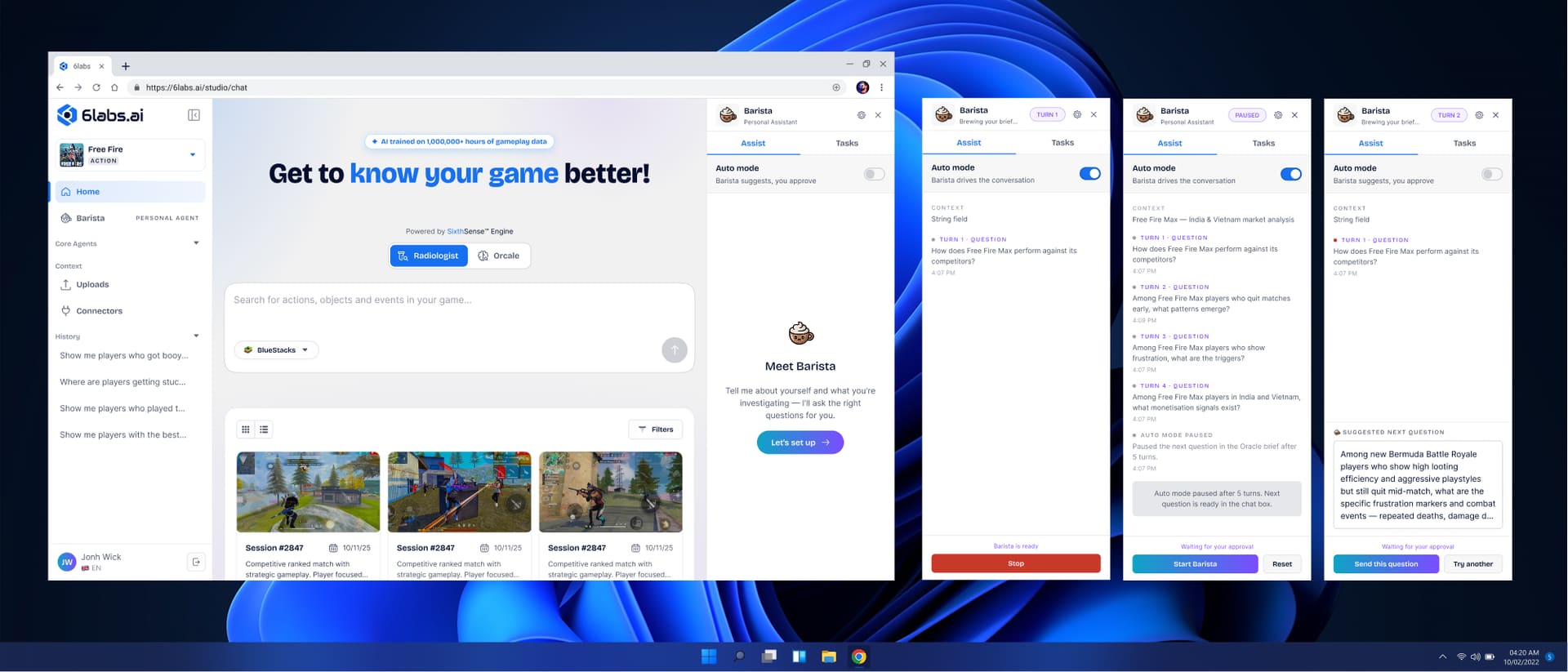
Barista — the assistant that proposes the question.
The dev problem
Devs didn’t need more agents. They needed an entry point that knew which question to ask, for which role, on which signal — without making the dev the query writer.
What we built
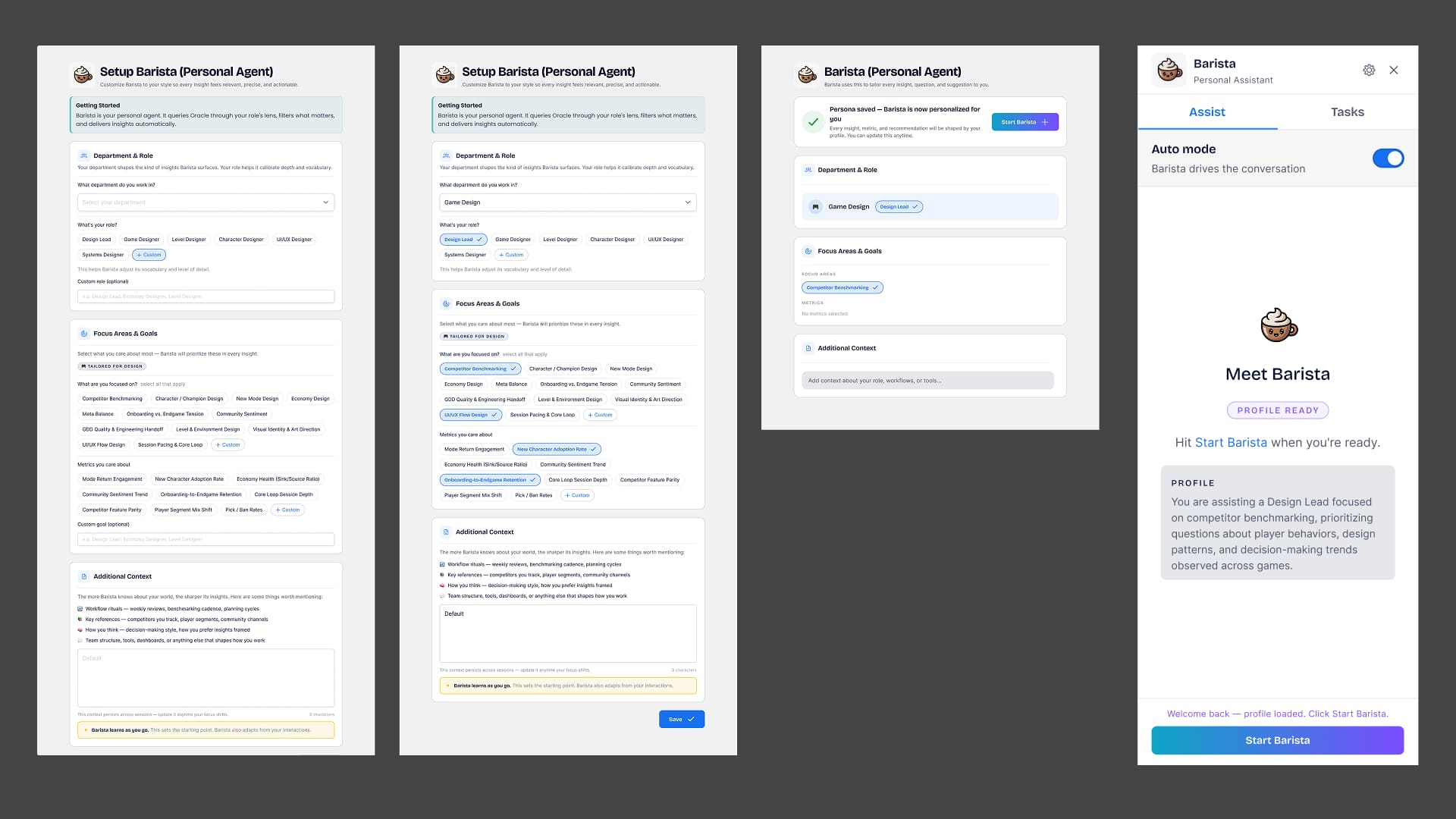
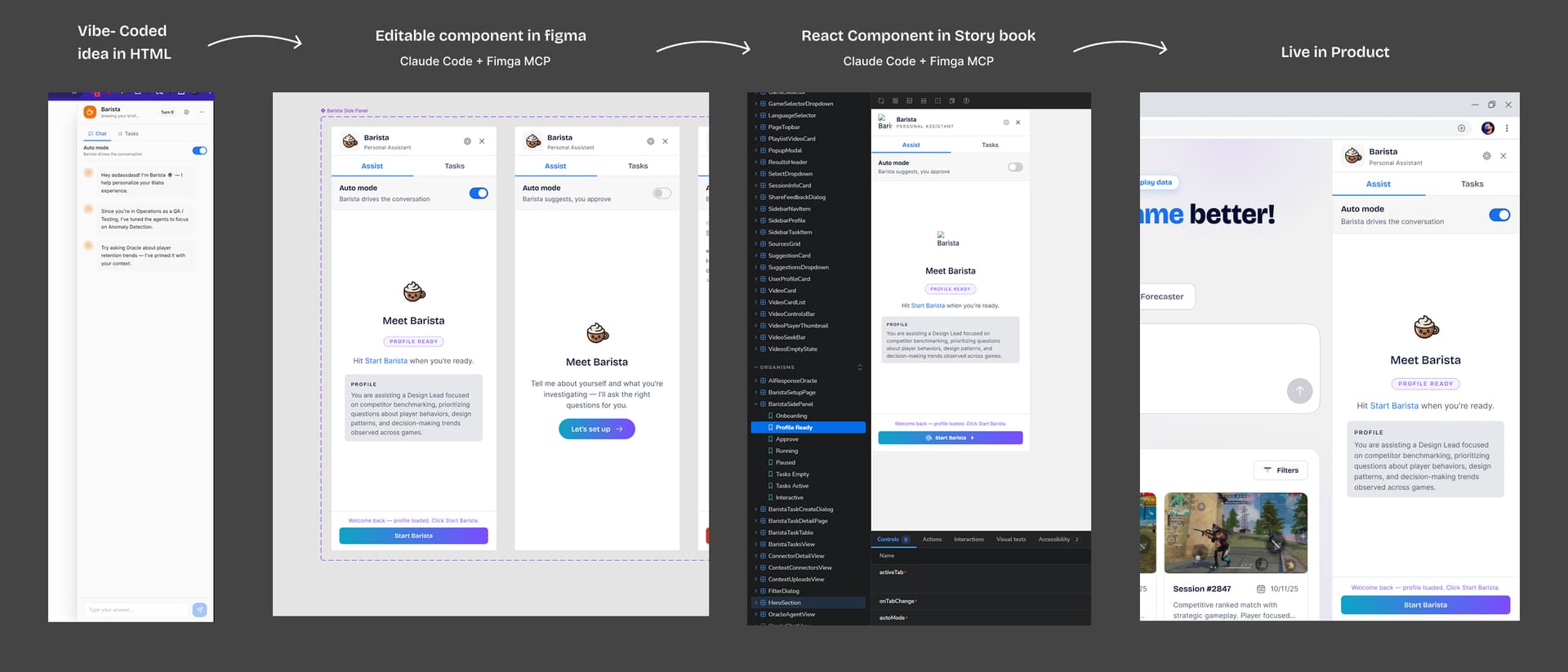
Barista — a personal assistant that proactively suggests analyses based on the dev’s role on the team (PM, game designer, LiveOps, marketer) and the data flowing in. Sits above Radiologist and Oracle: Barista decides which agent to invoke and frames the result in language the role understands.
What we learned
Most users now land in Barista first. Radiologist and Oracle stay accessible as the depth — but the on-ramp is what unlocked them.
Decision
Barista is the default surface; the other agents are reachable through it or directly.
HELD BACKGUARDIAN · AD FRAUD
Guardian. The agent we chose not to ship.
What it does
Detects ad fraud across player sessions and gathers video evidence to recover wasted UA spend.
Why it didn't ship with the others
Fraud detection is sensitive territory — it deals with real ad spend and real accusations against real partners. We chose to push it back, raise the accuracy bar, and run more testing before making it available. Shipping discipline mattered more than shipping count.
Decision
Held back on purpose: fraud detection touches real ad spend and real partners, so we raised the accuracy bar before making it available.
§04Built in an AI-native workflow.process
Designed in an AI-native workflow: Figma↔code round-trips through Claude Code, custom skills for the team, internal workshops for the wider org.
6labs.ai was designed in an AI-native workflow — Figma↔code round-trips through Claude Code, custom Claude Code skills built for the team, and internal AI workshops to bring the broader org along.
Four agents live with Barista as the default surface; the pilot tour doubled as usability research and 12 studios signed in 30 days.
Four agents (Barista, Radiologist, Oracle, Forecaster) powered by the SixthSense™ Engine — the platform's name for the gameplay-trained model layer underneath. Barista is the default landing experience; Radiologist and Oracle are reached through it or directly.
The 4-agent surface
Barista (assistant), Radiologist (deep session inspector), Oracle (behavioural intelligence), Forecaster (predictive personas) — all powered by the SixthSense™ Engine. Barista is the default surface; Radiologist and Oracle reachable through it or directly.
Oracle — focused query flow
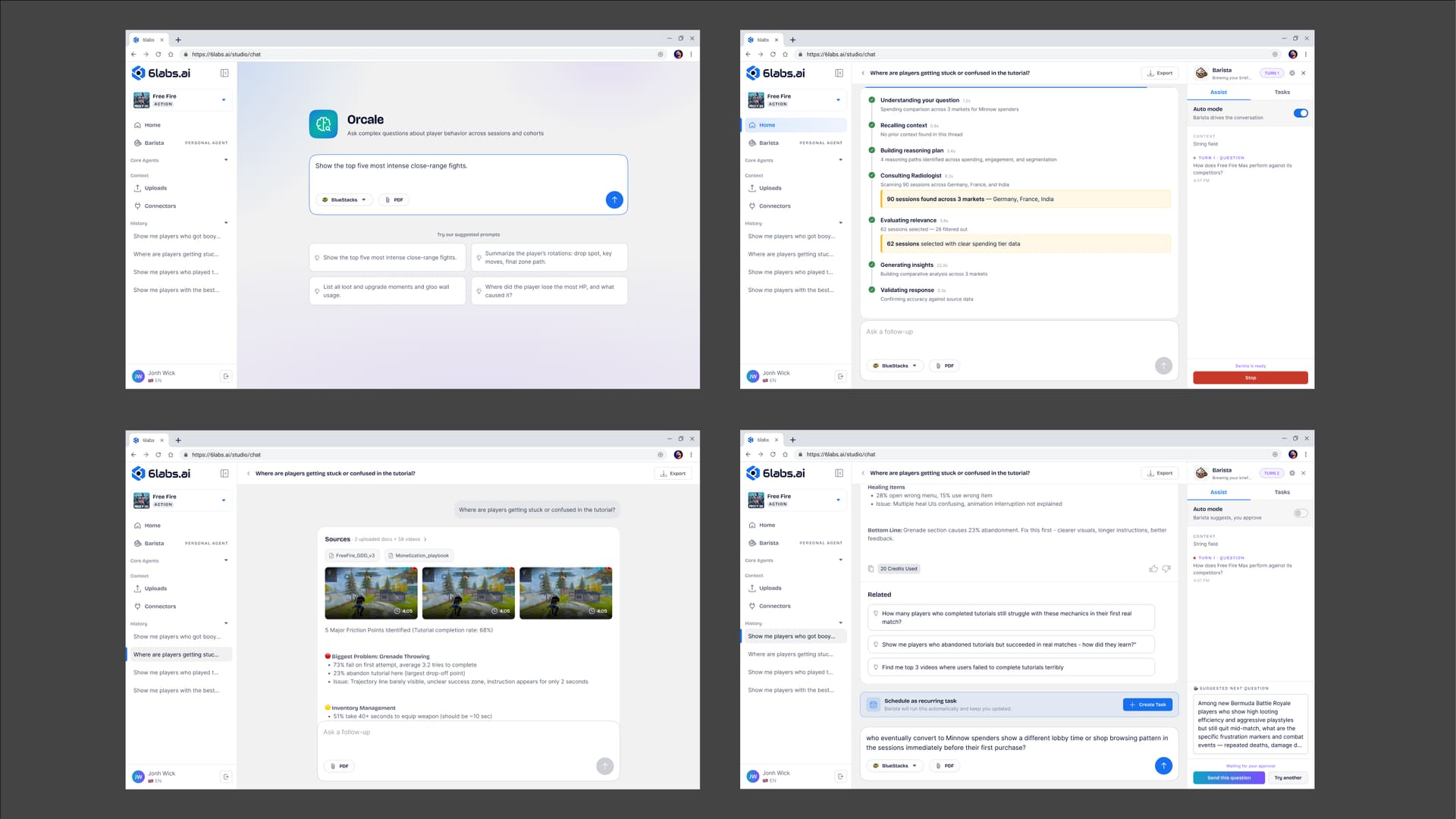
A dev asks a focused question across many sessions — “where did players lose the most HP and what caused it?” — and Oracle answers with grounded video evidence underneath. The most novel capability and the easiest to anonymise; this is the flow that demos best in pilot meetings.
Barista — proactive suggestion card
Barista decides which agent to invoke and frames the result in language that fits the dev’s role on the team (PM, game designer, LiveOps, marketer). The on-ramp that solved query authoring — devs land here first.
Pilot tour
Demos in US, Japan, and Korea, including a Free Fire–class title. Responses positive across regions.
Commercial signal
12 studios signed in 30 days. Devs paying to use the product, not engagement clicks.
How we read it
The pilot tour functioned as our usability research. Every studio meeting was a study we couldn't have run earlier with a static product.
§06What I'd do differently.reflection
Prototype against devs' real questions before any infra: we caught the “what would I even ask?” gap six months late.
01 · AI-native, day one
Integrate the Figma↔code round-trip from day one.
I brought my round-trip workflow in partway. Doing it from the start would have kept the design system tighter in code, and I'd have used dev branches as a design exploration surface, not a downstream artifact.
02 · Prototype against real test cases
Iterate on real test cases with working prototypes before any infra.
Before Iteration 1's POC, we should have run working prototypes against the real questions devs were trying to ask — the “what would I even ask this?” gap that Barista eventually solved. We caught it post-launch of Iteration 2 — six months late.
03 · Eval rubrics, week one
Co-author agent-eval rubrics with PMs from week one.
With agents, “looks right” isn't a quality bar — you need pre-defined eval cases, co-authored with PMs at concept time. We're catching up on this now.